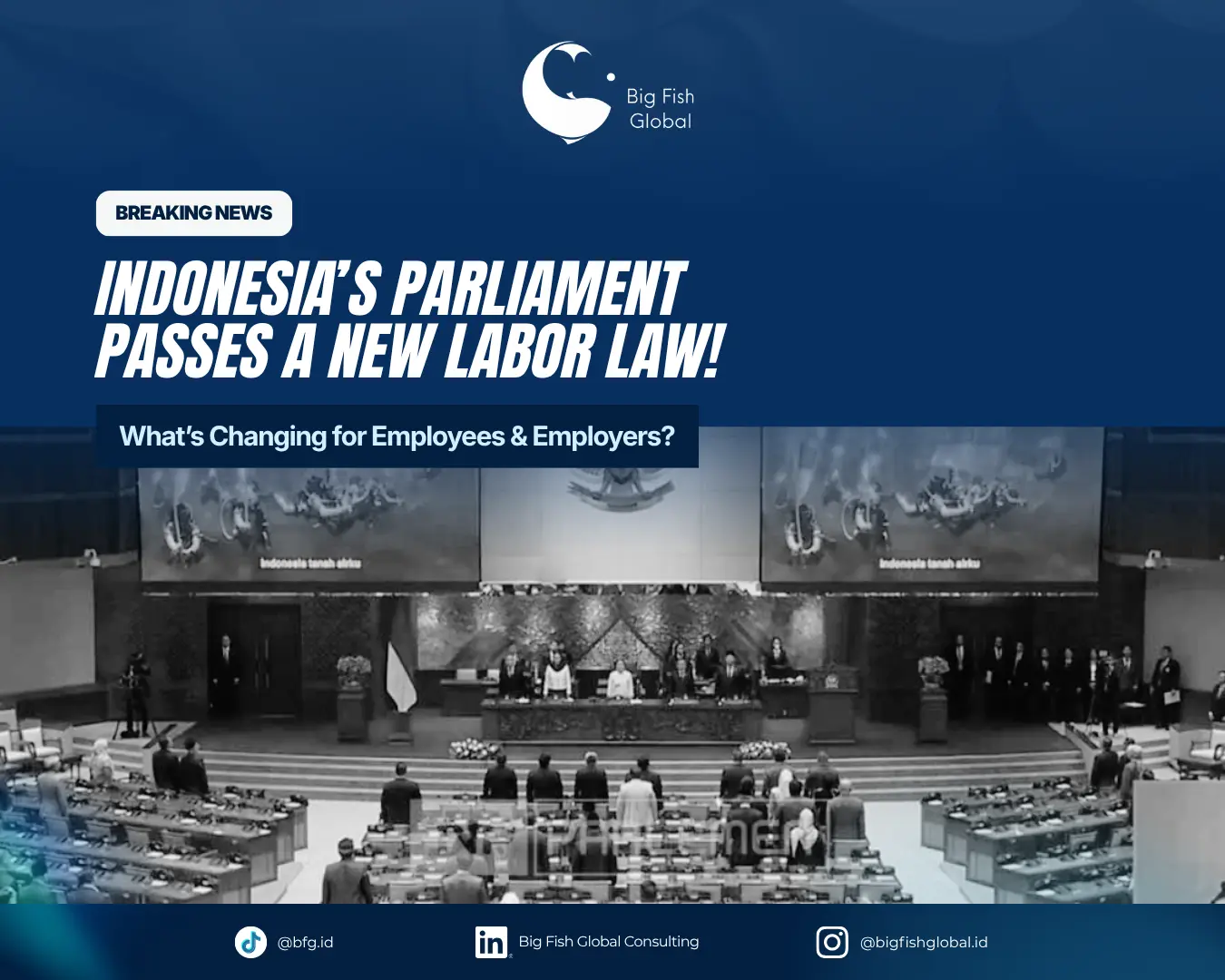
Indonesia’s employment framework is entering a new stage following the approval of the RUU Pelindungan Ketenagakerjaan on 6 October 2026.
The new legislation is broader than a change to termination rules. The framework is intended to strengthen worker rights, social security, employment relationships, occupational safety and health, protection for vulnerable workers, wage policy, and legal certainty for both workers and employers.
For companies planning to hire in Indonesia, particularly foreign companies entering the market for the first time, the development matters because employment compliance is part of the operating model from the moment the first employee is hired.
New Employment Law Indonesia 2026 Is Broader Than a Change to Termination Rules
The RUU Pelindungan Ketenagakerjaan was approved by the DPR on 6 October 2026 after discussions involving the government, employers, workers, academics, and other stakeholders.
According to the DPR’s explanation, the legislation is intended to strengthen normative worker rights, social security, employment relationships, occupational safety and health, protection for vulnerable workers, wage policy, and enforcement.
The legislation reportedly consists of 23 chapters and 313 articles. However, companies should distinguish between the parliamentary approval of the bill and the final published legislation that will determine the exact legal obligations, effective date, and transitional arrangements.
The DPR’s official explanation of the employment protection bill provides the current legislative context.
For employers, the practical question is therefore not simply, “What changed?”
The more useful question is:
What will this change mean for the way employment relationships are created, managed, documented, paid, and ended in Indonesia?
What the New Employment Law Means for Workers
New Employment Law Indonesia 2026 Puts Worker Protection at the Centre
From the worker’s perspective, the most important point is that the new framework is designed around broader employment protection rather than one isolated employment issue.
The DPR has described several areas that are expected to receive stronger attention, including:
- normative employment rights;
- social security protection;
- employment relationship status;
- occupational safety and health;
- protection for vulnerable workers;
- wage policy;
- workforce competency and productivity; and
- enforcement of employment regulations.
This means employees should not look at the new framework only through the question of salary or termination compensation.
The employment relationship itself becomes more important.
Workers should understand what type of employment relationship they have, what their employment documents say, what statutory protections apply to them, and how their rights are administered by their employer.
Employment Documents Still Matter
A change in legislation does not eliminate the importance of the employment agreement.
Employees should continue to review the documents governing their employment, including the employment agreement, company policies, compensation arrangements, working conditions, and applicable statutory benefits.
This is particularly important when the employee’s actual working arrangement differs from what is written in the employment documentation.
For employers, this creates an equally important responsibility.
A company entering Indonesia should not treat employment documentation as paperwork that can be completed after recruitment. The employment model should be determined before the first employee starts working.
Companies that are still establishing their workforce structure can review the broader Indonesia Employment Law 2026 guide to understand the wider employment framework.
Termination Is One of the Areas Workers Will Watch Closely
Termination naturally attracts significant attention whenever employment legislation changes.
Workers want to know what happens when an employment relationship ends, while employers need to understand their obligations before making a termination decision.
However, the new law should not be reduced to a simple question of whether severance is increasing or decreasing.
Termination sits within a much larger employment framework.
The legality of the employment relationship, the reason for termination, the employment documentation, the applicable procedures, and the employer’s obligations can all affect how an employment relationship should be ended.
Employees dealing with termination issues should therefore look beyond a single compensation figure and consider the complete employment relationship.
For a more focused explanation of the existing termination framework, see Termination Indonesia.
Severance Should Be Understood as Part of the Employment Relationship
Severance is one of the subjects that workers and employers are likely to examine closely as the new framework moves from legislation into implementation.
But employers should avoid building future employment budgets around unverified assumptions about new severance formulas.
At the time of writing, the final published legal text and implementing framework should be checked before applying any new calculation to an actual employee case.
This distinction matters because parliamentary approval and operational implementation are not necessarily the same stage.
What the New Employment Law Means for Companies Entering Indonesia
New Employment Law Indonesia 2026 Changes How Employers Should Think About Workforce Risk
For a foreign company entering Indonesia, employment law should be considered before recruitment rather than after an employee has been hired.
The first employee creates several obligations at the same time.
The company must consider the employment relationship, payroll, statutory contributions, employment documentation, HR administration, workplace policies, and compliance responsibilities.
For companies planning to employ foreign workers, these considerations also extend to foreign-worker positions, workforce localization, RPTKA, language requirements, knowledge transfer, and employer responsibilities. Our guide to Indonesia’s new employment law for foreign workers covers these issues in greater detail.
This is why market entry planning and employment planning should be connected.
A company researching how to expand a business into Indonesia should evaluate its employment model alongside its investment and operational structure.
A Foreign Company Should Understand the Employment Model Before Hiring
A foreign company entering Indonesia generally needs to decide how it will employ its local workforce.
That decision may involve establishing a local entity, working through an appropriate employment structure, or using an Employer of Record where appropriate.
The choice affects who is responsible for employment administration and how the company manages compliance.
An Employer of Record can be relevant for companies that need to employ people in Indonesia while they evaluate their longer-term market-entry structure. However, an EOR does not remove the need to understand Indonesian employment obligations.
Companies should therefore treat Employer of Record Indonesia as an operating structure to evaluate, not as a shortcut around employment compliance.
Companies Should Revisit Their Employment Cost Assumptions
Employment cost is more than an employee’s gross salary.
An employer may need to account for statutory contributions, payroll taxes, benefits, leave, employment administration, recruitment costs, and other workforce-related obligations.
When employment legislation changes, companies should review the assumptions behind their workforce budgets instead of simply increasing or decreasing one line item.
The right approach is to model the complete employment relationship.
For companies that need a clearer view of payroll obligations, Payroll Services Indonesia can be evaluated as part of the broader HR operating model.
Termination Planning Starts Before Recruitment
Termination is often treated as a final-stage HR issue.
For foreign companies, that can create unnecessary risk.
The employment structure should be designed with the full employment lifecycle in mind:
Recruitment → Employment → Payroll → Performance → Changes → Termination
Each stage creates records and responsibilities that may become important later.
This is one reason companies should review their employment contracts and HR policies before hiring rather than trying to reconstruct documentation after a dispute occurs.
Foreign Companies Should Review Their HR Policies
A new employment framework is also a reason for employers to review internal HR policies.
The review should consider whether current policies remain aligned with applicable employment requirements, particularly in areas such as:
- employment relationships;
- compensation and wage administration;
- working conditions;
- leave;
- social security;
- occupational safety and health;
- disciplinary procedures;
- termination procedures; and
- employee documentation.
Companies operating in Indonesia can also review their broader HR compliance requirements when updating internal policies.
The First Employee Creates a Compliance Decision
For a foreign company, hiring the first employee in Indonesia is more than a recruitment decision.
It creates a local employment relationship that needs to be administered correctly.
Before making the hire, the company should answer several practical questions:
Who will legally employ the person?
Who will prepare and maintain employment documents?
Who will calculate payroll and statutory obligations?
Who will administer employee benefits and social security?
Who will maintain HR records?
Who will manage changes to the employment relationship?
Who will handle termination if the employment relationship ends?
These questions become especially important when headquarters is located outside Indonesia and the local team is small.
A company with one or two employees may not need a large HR department, but it still needs a clear ownership model.
What Workers and Employers Should Review Now
For Workers
Employees should focus on understanding their existing employment relationship rather than assuming every provision of the new framework applies immediately.
A practical review includes:
- checking the employment agreement;
- understanding the employment status;
- reviewing compensation and statutory benefits;
- checking social security participation;
- understanding workplace policies;
- keeping copies of important employment documents; and
- following official announcements as the new framework is implemented.
Workers should rely on the final published legislation and implementing regulations when assessing a specific legal right.
For Employers
Employers should begin with an internal review rather than immediately changing every employment policy.
A sensible review can include:
- Identify which employees and employment arrangements may be affected.
- Review existing employment agreements.
- Review HR policies and employee handbooks.
- Check payroll and statutory contribution processes.
- Review termination procedures.
- Identify areas that depend on implementing regulations.
- Update policies only after the applicable legal requirements are confirmed.
Companies should avoid making changes based solely on headlines or preliminary interpretations.
What Is Confirmed and What Still Needs to Be Watched?
The approval of the RUU Pelindungan Ketenagakerjaan is a significant legislative development.
The DPR’s official publication confirms the broad direction of the framework and states that the bill covers worker rights, social security, employment relationships, occupational safety and health, vulnerable workers, wage policy, workforce development, and legal certainty for businesses.
However, companies should distinguish between what has been publicly confirmed about the legislation and what still requires verification from the final legal text.
Before making operational changes, employers should verify:
- the final law number;
- the date of promulgation;
- the effective date;
- transitional provisions;
- implementing regulations;
- changes to existing employment regulations; and
- the final wording of provisions affecting their workforce.
Employers can monitor the JDIH Kemnaker legal database for published employment regulations and official legal documents.
What Foreign Companies Should Monitor Next
Final Publication of the Law
Parliamentary approval is an important legislative milestone, but companies should use the officially promulgated legal text as the basis for compliance decisions.
This is particularly important for foreign companies because small differences between a legislative summary and the final legal wording can have significant operational consequences.
Effective Date
Companies should determine when the new obligations actually become effective.
The effective date matters because employers need to know whether an existing employment arrangement must be changed immediately, at renewal, or only after a specified transition period.
Transitional Provisions
Transitional provisions can determine how the new rules interact with employment relationships that already exist.
This can be particularly important for companies with employees already working in Indonesia.
Implementing Regulations
Some employment obligations require more detailed regulations before companies can implement them operationally.
Employers should therefore avoid changing payroll calculations, employment contracts, or HR policies solely on the basis of a general legislative announcement.
Changes to Existing Employment Regulations
The new framework may also affect how companies interpret or apply existing employment regulations.
For that reason, HR teams should review the relationship between the new law and the regulations already used in their employment processes.
The New Law Should Become Part of the Indonesia Market-Entry Plan
For companies considering Indonesia, employment law should not be treated as a compliance issue that appears after the investment decision.
It should be part of the market-entry plan from the beginning.
A company deciding between establishing a local entity, hiring directly, or using an alternative employment structure needs to understand the workforce implications of each option.
The decision is particularly important when the company is testing the Indonesian market with a small team.
A business may have a strong commercial strategy but still create unnecessary risk if its first employee is hired without a clear employment, payroll, and HR structure.
This is where the relationship between Indonesia market entry strategy and employment planning becomes important.
The new employment framework reinforces the idea that workforce planning is not separate from market entry.
It is part of market entry.
Two Perspectives, One Employment Framework
The new employment law matters to workers and employers for different reasons.
For workers, the focus is protection: employment rights, social security, working conditions, safety, wages, and protection throughout the employment relationship.
For employers, the focus is certainty: knowing how employment relationships should be structured, documented, administered, and managed.
For foreign companies, there is a third consideration.
Employment compliance is part of the cost and risk of entering Indonesia.
The most useful response is therefore not to react to headlines, but to understand the final legal framework, identify which employment arrangements may be affected, and update the company’s HR and payroll processes once the applicable rules are confirmed.
As the new framework moves from legislative approval toward implementation, both workers and employers should continue relying on official publications rather than preliminary interpretations.
For companies entering Indonesia, the objective should be simple: build an employment structure that is compliant from the first employee and capable of adapting as the workforce grows.