For foreign companies entering Indonesia, hiring a foreign employee can initially look like a staffing decision: identify the right person, arrange the required authorization, and put the employee into the Indonesian operation.
Before making these decisions, companies should understand the broader Indonesian employment law developments affecting foreign workers.
The new employment framework makes that decision more strategic.
The question is no longer simply whether a company can bring a foreign employee into Indonesia. Companies also need to consider why the position requires foreign expertise, how the role fits into the Indonesian workforce, and what capability should remain after the foreign employee’s assignment ends.
On 6 October 2026, the DPR approved the RUU Pelindungan Ketenagakerjaan to become an Undang-Undang. The official announcement from the Directorate General of Legislation of the Ministry of Law confirms that the approval took place during the DPR’s plenary session. DJPP
However, companies should distinguish the legislative approval from the operational rules that will determine how individual provisions are implemented. As of 8 October 2026, the JDIH Kementerian Ketenagakerjaan’s 2026 regulations database does not yet show a final law entry for Pelindungan Ketenagakerjaan. JDIH Kementerian Ketenagakerjaan
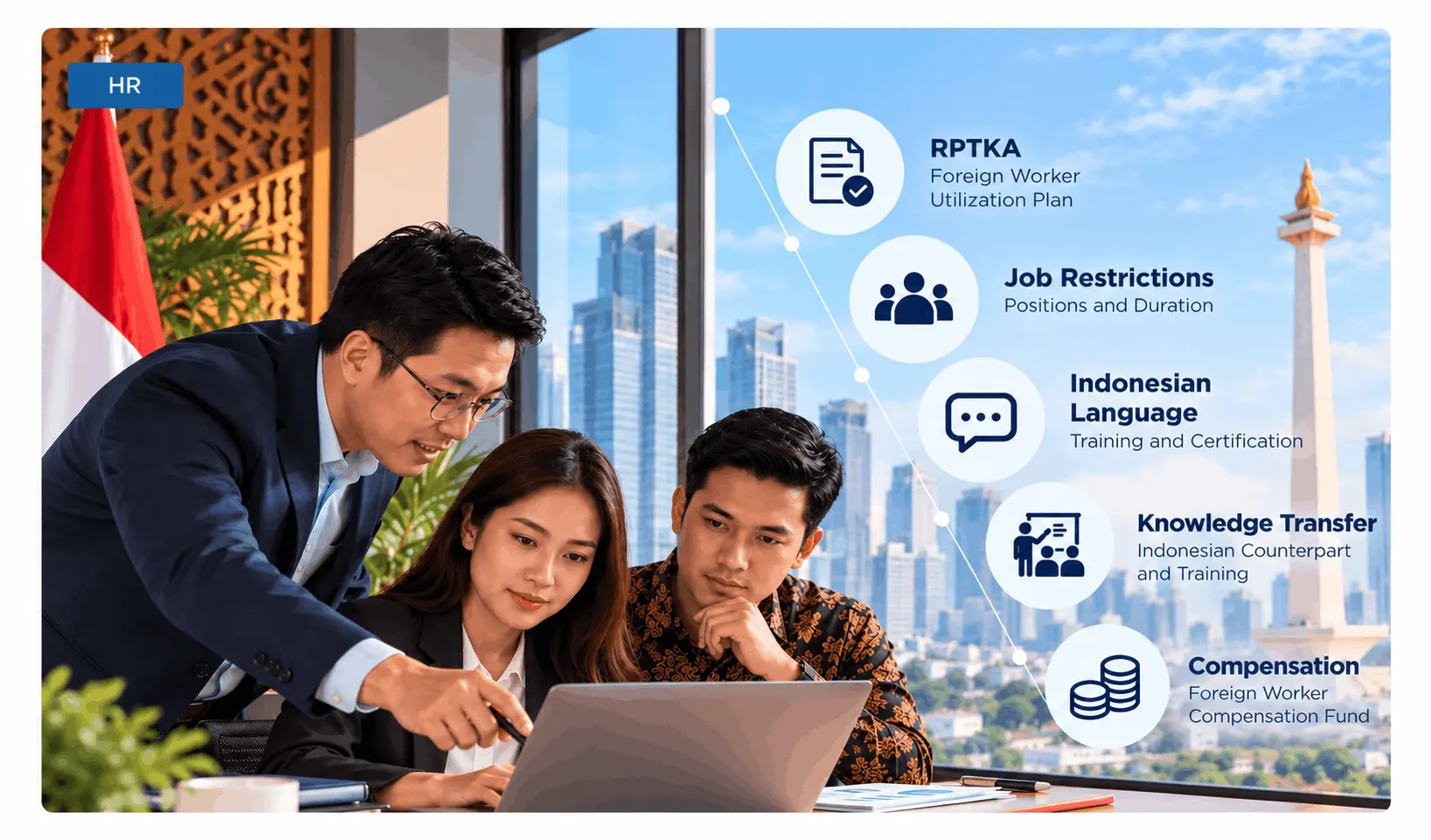
For foreign employers, the foreign-worker provisions in the draft text are particularly relevant. They address foreign-worker planning, eligible positions, Indonesian workforce priority, knowledge transfer, language capability, compensation, and employer responsibilities.
The First Question Is No Longer Simply Whether the Company Can Hire a Foreign Worker
A foreign company may have a legitimate reason to bring an employee from headquarters.
A Chinese manufacturing group might need an experienced engineer to establish a production line. A technology company might need a specialist who understands its proprietary systems. A data center operator may need international technical personnel during an initial commissioning phase.
The business reason can be valid.
But the role still needs to be examined independently from the employee.
The draft framework states that foreign workers may be employed in Indonesia only for certain positions and periods and must have competencies appropriate to the position. It also states that foreign workers may only be employed for positions that cannot be filled by Indonesian workers, while employers must prioritize Indonesian workers. komisi9-RJ-20260928-034348-6645
That changes the starting point for workforce planning.
Instead of asking:
“Which expatriate should we send to Indonesia?”
management should first ask:
“Which position genuinely requires foreign expertise?”
That distinction can prevent a common expansion mistake: transferring people from headquarters simply because they are already familiar with the business.
Indonesia New Employment Law 2026 Puts More Attention on the Position
The employee and the position are not the same compliance question.
A foreign employee may be highly qualified, but that does not automatically explain why the Indonesian operation needs that particular position to be occupied by a foreign worker.
For each proposed foreign-worker position, management should be able to explain:
- what specialized capability is required;
- why the capability is not immediately available locally;
- how long the expertise is expected to be needed;
- what responsibilities the employee will actually perform;
- and whether Indonesian employees will eventually be able to assume those responsibilities.
This is especially important for companies building their first Indonesian team.
The workforce structure created during the first year can easily become the company’s default structure for years afterward. If foreign positions are created without a clear reason, the company may eventually find itself maintaining an expatriate-heavy organization without having deliberately planned for localization.
RPTKA Should Be Connected to Workforce Planning
The draft requires an employer that employs foreign workers to have a foreign-worker utilization plan approved by the Minister, subject to specified exceptions. It also provides administrative sanctions for employers that do not have the required plan.
That makes the foreign-worker utilization plan more than a document that HR prepares when an expatriate is ready to arrive.
It should reflect the company’s actual workforce requirement.
For example, suppose a foreign company plans to establish an Indonesian subsidiary and initially wants to transfer five employees from headquarters:
- one country manager;
- two technical specialists;
- one finance manager;
- one operations manager.
The company should not automatically treat all five positions in the same way.
The technical specialists may bring knowledge that is difficult to recruit locally during the early stage. The country manager may have a different business justification. The finance function may potentially be filled locally much sooner.
A workforce plan that treats every expatriate position as permanent can therefore produce a very different result from one that distinguishes between initial expertise and long-term local capability.
Foreign Workers Can Become Part of a Knowledge-Transfer Structure
One of the more significant elements in the draft is the relationship between foreign workers and Indonesian workforce development.
For foreign workers engaged in technology and expertise transfer, the draft requires employers to use foreign workers capable of communicating in Indonesian, appoint Indonesian workers as counterparts, and provide relevant education and training. komisi9-RJ-20260928-034348-6645
The explanatory material provides an important detail: the Indonesian counterpart is not automatically expected to replace the foreign worker immediately. The purpose of the arrangement is to facilitate the transfer of technology and expertise so that the Indonesian worker develops the capability to eventually take over the function. komisi9-RJ-20260928-034348-6645
That makes the foreign-worker assignment more than an individual staffing arrangement.
The company needs to think about the capability being transferred.
The Indonesian Counterpart Should Have a Real Role
If a foreign engineer is sent to Indonesia to establish a specialized production process, appointing an Indonesian employee simply to satisfy a formal requirement would miss the larger purpose of the arrangement.
The counterpart should be positioned to understand the work.
That could involve:
- participating in technical decisions;
- documenting operating procedures;
- receiving structured training;
- working directly with the foreign specialist;
- learning troubleshooting processes;
- and eventually assuming part or all of the responsibility.
This also changes how companies should evaluate the success of an expatriate assignment.
The question is not only whether the foreign employee completed the project.
It is also whether the Indonesian organization became more capable because the employee was there.
Indonesian Language May Become a Workforce Planning Issue
Language is another area foreign employers should examine carefully.
Under the draft, employers must facilitate Indonesian-language education and training for relevant foreign workers. For foreign workers covered by the technology and expertise transfer provision, Indonesian-language competence must be demonstrated through certification. komisi9-RJ-20260928-034348-6645
The draft also identifies exceptions, including directors and commissioners, heads of representative offices, certain foundation positions, and foreign workers engaged for temporary work. komisi9-RJ-20260928-034348-6645
This does not mean every foreign employee in Indonesia should automatically be treated as subject to the same language requirement.
The role matters.
A company therefore needs to determine whether the position falls within the relevant provision, whether an exception applies, and what language training or evidence may be required.
For HR teams, this means language should not necessarily be treated as an afterthought once the employee has arrived.
It may need to become part of the assignment design itself.
The Cost of a Foreign Worker Goes Beyond Salary
Another issue is financial planning.
The draft requires employers to pay compensation for the use of foreign workers, subject to specified exemptions. It states that the amount and use of the compensation fund will follow the applicable regulations, while non-payment can result in administrative sanctions. komisi9-RJ-20260928-034348-6645
This means companies should avoid evaluating expatriate costs based only on gross salary.
Depending on the assignment, the overall employment cost can involve:
- salary;
- allowances;
- payroll tax;
- immigration-related expenses;
- foreign-worker administration;
- compensation obligations;
- relocation;
- accommodation;
- language training;
- and local workforce development.
The payroll structure should also be consistent with the employment arrangement. Companies can review their broader Payroll for Foreign Employees in Indonesia guidance when assessing how expatriate compensation fits into the Indonesian payroll process.
The important point is that foreign-worker cost should be evaluated as part of the company’s operating model, not as a separate visa expense.
Workforce cost planning should also account for Indonesia’s national holidays and collective leave arrangements. These dates can affect employee scheduling, payroll preparation, and business continuity throughout the year. For a practical reference, see our guide to Indonesia public holidays 2027, which explains the official holiday calendar and key HR considerations for employers.
A Foreign Worker Should Not Automatically Become a Permanent Workforce Solution
Consider a company entering Indonesia for the first time.
Its headquarters may have a manager who understands the company’s systems, processes, and regional strategy better than anyone locally.
Sending that person to Indonesia may be sensible.
But the company should also decide what the organization should look like two or three years later.
If the answer is still:
“We need exactly the same foreign employee doing exactly the same role,”
the company may have created a permanent dependency.
A different model would be:
Foreign specialist → Indonesian counterpart → local capability → reduced dependency
That does not mean every foreign worker must eventually be replaced.
Certain international roles may remain necessary.
The important distinction is whether the company has consciously chosen that structure or simply allowed the initial expatriate arrangement to become permanent.
Indonesia New Employment Law 2026 Makes Localization More Relevant
The foreign-worker provisions should therefore be considered alongside the company’s Indonesian recruitment strategy.
A company that sends a technical expert should be thinking about who will eventually manage the technical function locally.
A company that sends an operations manager should be developing Indonesian management capability around that person.
A company that sends a project specialist should know whether the project itself is temporary or whether the position will remain after the project ends.
This is where foreign-worker compliance intersects with broader Labor Compliance Indonesia planning.
The objective is not simply to make the expatriate arrangement compliant.
It is to make the workforce structure sustainable.
What Existing Foreign Employers Should Review
Companies already employing foreign workers do not necessarily need to change every arrangement immediately.
A more useful first step is to review the foreign-worker positions one by one.
For each employee, ask:
What does the employee actually do?
Job titles can be misleading. A “Regional Manager” may perform operational work in Indonesia, while a “Technical Advisor” may effectively manage a local function.
Why does the position require foreign expertise?
The business reason should be clear enough for management and HR to explain consistently.
Who works alongside the employee?
If the role involves knowledge or technology transfer, identify the Indonesian employees receiving that knowledge.
What happens when the assignment ends?
The company should know whether the role will be localized, replaced by another specialist, or remain an international position.
Do the records tell the same story?
The business description, HR records, foreign-worker documentation, employment contract, payroll treatment, and actual responsibilities should not contradict each other.
This review is much more useful than simply checking whether each employee has a complete document folder.
The Biggest Mistake Is Treating Foreign-Worker Compliance as an Immigration Task
Foreign-worker management sits across several business functions.
Business decides why the expertise is needed.
HR structures the employment relationship.
Legal and compliance assess the applicable employment requirements.
Immigration manages the relevant stay and work authorization.
Payroll handles salary, tax, and statutory employment administration.
Management determines whether the assignment is actually delivering the intended business result.
Problems often appear when each department sees only its own part.
For example, the business may describe someone as a technical specialist while the employee’s actual Indonesian responsibilities have gradually expanded into management. HR may retain the original job description while the operational team treats the employee as the head of a local function.
A stronger approach starts with the actual role and then keeps the different compliance records aligned.
Foreign Companies Should Design the Workforce Before Sending the First Expatriate
For companies that have not yet entered Indonesia, the new framework creates an opportunity to make the workforce structure more deliberate.
The first question should be:
What does the Indonesian operation need to achieve during its first stage?
A company establishing manufacturing operations may need technical expertise during setup.
A technology company may need a specialist to establish systems and transfer knowledge.
A regional company may need a country manager during market entry.
A company testing the Indonesian market may need a much smaller structure.
These situations should not automatically produce the same expatriate model.
That is why foreign-worker planning should be connected to the company’s Indonesia market entry strategy rather than treated as an isolated visa process.
What Companies Should Prepare Before the Rules Are Fully Operational
The final legal and implementing framework will determine the precise operational requirements.
Companies should therefore avoid presenting every provision in the draft as if it were already an effective operational rule.
At the same time, there is no reason for employers to wait before reviewing their workforce structure.
Three areas deserve attention now.
Review the Foreign Workers Already in Indonesia
Create an inventory of current foreign employees.
For each person, document the actual position, business reason, duration, responsibilities, Indonesian counterparts, compensation structure, and expected future role.
This creates a baseline before the new framework is operationalized.
Review Planned Foreign-Worker Positions
For upcoming hires, define the role before selecting the employee.
The company should know why foreign expertise is needed and what the employee is expected to accomplish.
This is particularly important for companies planning to transfer several employees from headquarters at the same time.
Review Local Capability Around the Role
Identify the Indonesian employees who can work alongside the foreign specialist.
Where the assignment involves knowledge or technology transfer, determine what those employees need to learn and how the company will measure progress.
That turns localization from a general intention into an operating process.
The End of the Assignment Matters as Much as the Beginning
Foreign-worker planning usually focuses heavily on recruitment and arrival.
The draft also requires employers to repatriate foreign workers to their country of origin after the employment relationship ends, subject to the applicable framework. komisi9-RJ-20260928-034348-6645
That makes the end of the assignment part of the planning process.
Before the foreign employee leaves, the company should know:
- who will take over the responsibilities;
- whether the Indonesian counterpart is ready;
- what knowledge has been transferred;
- whether operational documentation is complete;
- how payroll and employment records will be closed;
- and what remaining immigration or administrative steps need to be handled.
A successful assignment should therefore have an identifiable endpoint.
If the company reaches that endpoint and immediately needs to send another foreign employee to perform exactly the same function, management should ask whether enough local capability was developed during the original assignment.
A Better Way to Evaluate Every Foreign-Worker Position
Rather than relying on a generic expatriate checklist, companies can assess each position through five questions.
Why this person?
What expertise does the employee bring that the Indonesian operation genuinely needs?
Why this position?
Why does this particular role require foreign expertise?
Who learns from the employee?
Which Indonesian employees receive the relevant knowledge?
What happens later?
Is the role expected to remain international, or can local capability eventually be developed?
Can the company explain the arrangement consistently?
Do the business, HR, foreign-worker, payroll, and employment records describe the same position?
These questions give management something more useful than a document checklist: a way to determine whether the foreign-worker arrangement actually makes sense.
BigFish Global Consulting for Foreign Workforce Support in Indonesia
For foreign companies, workforce compliance in Indonesia often crosses several areas at once: employment structure, foreign-worker administration, payroll, HR, recruitment, and immigration.
BigFish Global Consulting provides HR Services Indonesia, Employer of Record, payroll, recruitment, and related workforce support for companies establishing and operating in Indonesia.
The appropriate structure depends on the company’s actual objective.
A company establishing a permanent Indonesian operation may require a different workforce model from a business transferring technical expertise for a limited project. The foreign-worker position should therefore be designed around the business requirement rather than treated simply as an expatriate hire.
The Real Question Is What the Foreign Worker Leaves Behind
The most important implication of the new employment framework is not simply that foreign companies may have additional compliance requirements.
It is that the role of foreign expertise within the Indonesian workforce is becoming more important to examine.
For companies already operating in Indonesia, this means reviewing why each foreign-worker position exists and whether its responsibilities remain appropriate.
For companies preparing to enter Indonesia, it means designing the workforce before transferring employees from headquarters.
And for companies using foreign specialists for technology or expertise transfer, it means thinking beyond the employee’s assignment and asking what capability should remain inside the Indonesian organization afterward.
The legislative approval is an important development, but the final operational picture will depend on the promulgated law and implementing regulations. The current JDIH Kemnaker database continues to show the existing 2026 regulatory framework rather than a published final entry for the new Pelindungan Ketenagakerjaan law. JDIH Kementerian Ketenagakerjaan
For that reason, companies should prepare their workforce structure now without treating every draft provision as an already-effective operational requirement.
The strongest preparation is straightforward:
Understand why each foreign-worker position exists, how it fits the Indonesian workforce, who works alongside the employee, and what the organization should look like when that assignment ends.